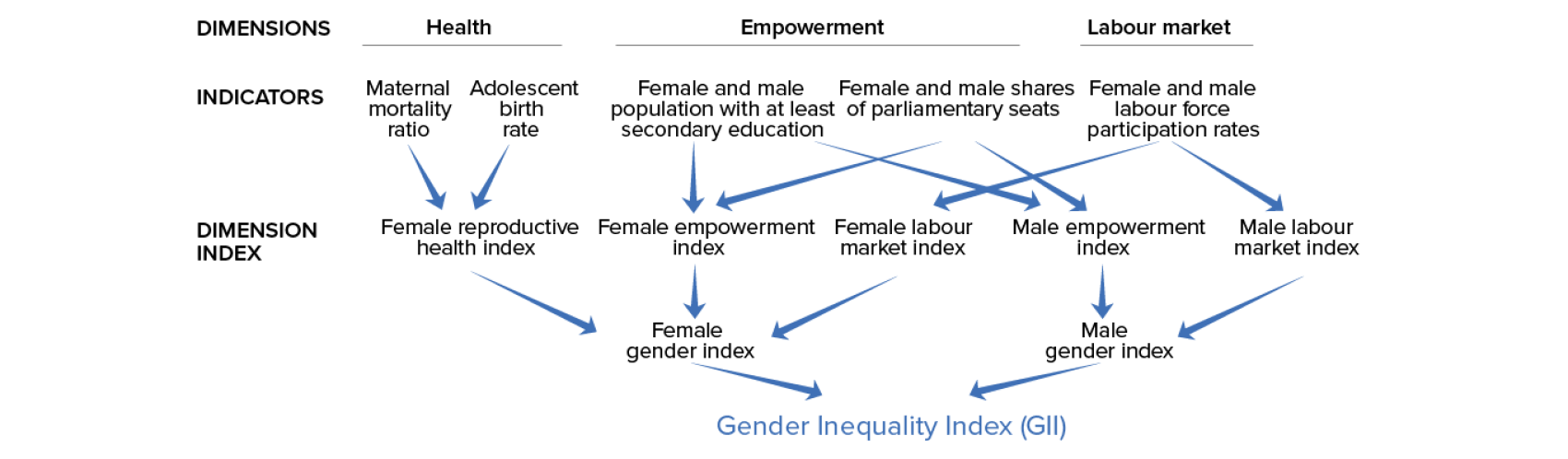
The disadvantages facing women and girls are a major source of inequality. All too often, women and girls are discriminated against in health, education and the labour market — with negative repercussions for their freedoms. We introduce a new measure of these inequalities built on the same framework as the HDI and the IHDI — to better expose differences in the distribution of achievements between women and men.

Gender inequality varies tremendously across countries—the losses in achievement due to gender inequality (not directly comparable to total inequality losses because different variables are used) range from 4.5 percent to 74.7 percent.
Countries with unequal distribution of human development also experience high inequality between women and men, and countries with high gender inequality also experience unequal distribution of human development. To learn more: HDR 2013 Technical Notes English [153 KB]
There is no country with perfect gender equality – hence all countries suffer some loss in their HDI achievement when gender inequality is taken into account, through use of the GII metric. The Gender Inequality Index is similar in method to the Inequality-adjusted Human Development Index (IHDI). It can be interpreted as a percentage loss to potential human development due to shortfalls in the dimensions included. Since the Gender Inequality Index includes different dimensions than the HDI, it cannot be interpreted as a loss in HDI itself. Unlike the HDI, higher GII values indicate lower achievement.
The world average score on the GII is 0.463, reflecting a percentage loss in achievement across the three dimensions due to gender inequality of 46.3%. Regional averages range from 28.0% in Europe and Central Asia, to nearly 58% in Sub-Saharan Africa. At the country level losses due to gender inequality range from 4.5% in the Netherlands, to 74.7% in Yemen. Sub-Saharan Africa, South Asia and the Arab States suffer the largest losses due to gender inequality (57.7%, 56.8% and 55.5% respectively).
No, there has been no change in calculation. As in 2011, maternal mortality ratio enters the Gender Inequality Index truncated at 10 which affects the range of Gender Inequality Index values which theoretically should be between 0 and 1. This is corrected by normalizing the maternal mortality ratio by 10. This intervention generally reduced the values of the Gender Inequality Index. To facilitate the comparison a trend of the Gender Inequality Index based on consistent time series data has been calculated.
The introduction in 1995 of the Gender-related Development Index (GDI) and the Gender Empowerment Measure (GEM) coincided with growing international recognition of the importance of monitoring progress in the elimination of gender gaps in all aspects of life. While the GDI and the GEM have contributed immensely to the gender debate, they have conceptual and methodological limitations. The Gender Inequality Index was introduced as an experimental index in 2010 as part of the 20th anniversary edition of the Human Development Report. Just as the HDI continues to evolve, the Gender Inequality Index will also evolve as and when data becomes available.
The GDI was not a measure of gender inequality: it was the HDI adjusted for gender disparities in its basic components and cannot be interpreted independently of the HDI. The difference between the HDI and the GDI appears to be small because the differences captured in the three dimensions tend to be small, giving a misleading impression that gender gaps are irrelevant. In addition, gender-disaggregated incomes have to be estimated in a very crude way using not so realistic assumptions due to the lack of income data by gender for over three-fourths of countries.
Both the GDI and GEM combined relative and absolute achievements. The earned income component uses both—the income level and the gender-disaggregated income shares. However, income levels tend to dominate the indices, and as a result, countries with low income levels cannot achieve a high score even with perfect gender equality in the distribution of earnings and other components of the indices. Nearly all of the GEM indicators reflect an elite bias, making the measure more relevant for developed countries and urban areas in developing countries.
The Gender Inequality Index introduces methodological improvements and alternative indicators. It measures inequality between genders in three dimensions, with carefully chosen indicators to reflect women’s reproductive health status, their empowerment and labour market participation relative to men’s. The Gender Inequality Index combines elements of the GDI and the GEM. Income, the most controversial component of the GDI and GEM, is not a component of the Gender Inequality Index. Moreover, the new Index does not allow high achievement in one dimension to compensate for low achievement in another dimension.