Highlight

Measuring Human Development: A Primer
Primer Highlight (JPG)
Read more

The Human Development Index (HDI)

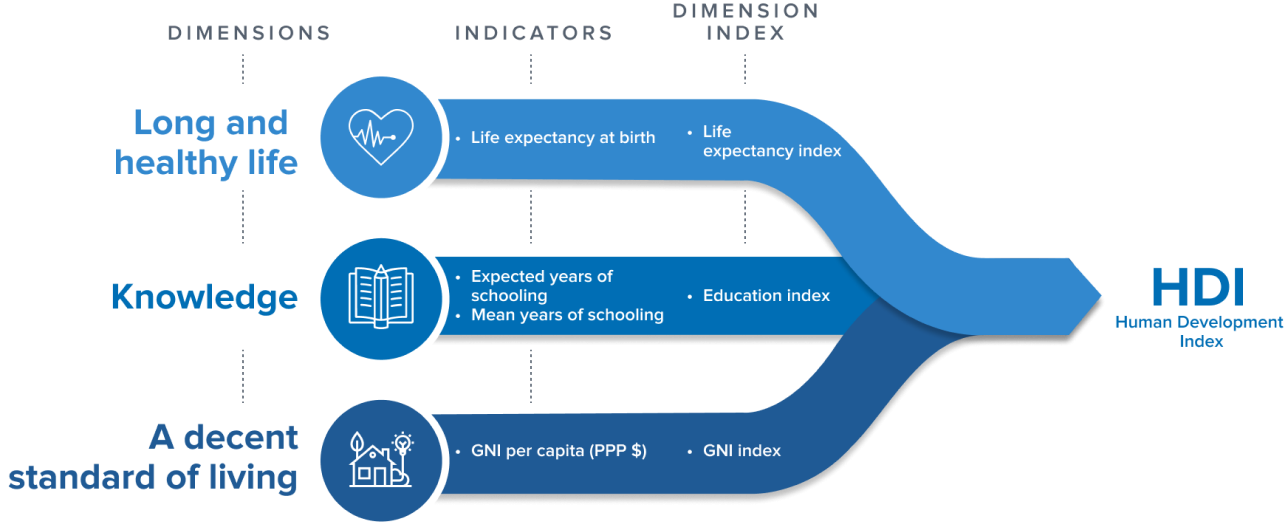
The first Human Development Report (1990) introduced a new way of measuring development by combining indicators of life expectancy, educational attainment and income into a composite human development index, the HDI (see box 1 below). The breakthrough for the HDI was the creation of a single statistic which was to serve as a frame of reference for both social and economic development. The HDI sets a minimum and a maximum for each dimension, called goalposts, and then shows where each country stands in relation to these goalposts, expressed as a value between 0 and 1.

The educational component of the HDI is comprised of adult literacy rates and the combined gross enrolment ratio for primary, secondary and tertiary schooling, weighted to give adult literacy more significance in the statistic. Since the minimum adult literacy rate is 0% and the maximum is 100%, the literacy component of knowledge for a country where the literacy rate is 75% would be 0.75, the statistic for combined gross enrolment is calculated in a analogous manner. The life expectancy component of the HDI is calculated using a minimum value for life expectancy of 25 years and maximum value of 85 years, so the longevity component for a country where life expectancy is 55 years would be 0.5. For the wealth component, the goalpost for minimum income is $100 (PPP) and the maximum is $40,000 (PPP). The HDI uses the logarithm of income, to reflect the diminishing importance of income with increasing GDP. The scores for the three HDI components are then averaged in an overall index. Refer to technical note 1 PDF Inline (GIF) Technical note 1 HDR 2007/2008 [5,680 KB] for more details.

The HDI facilitates instructive comparisons of the experiences within and between different countries.

The disaggregated HDI

One way the use of the human development index has been improved is through disaggregation. A country's overall index can conceal the fact that different groups within the country have very different levels of human development. Disaggregated HDIs are arrived at by using the data for the HDI components pertaining to each of the separate groups; treating each group as if it was a separate country. Such groups may be defined relative to income, geographical or administrative regions, urban/rural residence, gender and ethnicity. Using disaggregated HDIs at the national and sub-national levels helps highlight the significant disparities and gaps: among regions, between the sexes, between urban and rural areas and among ethnic groups. The analysis made possible by the use of the disaggregated HDIs should help guide policy and action to address gaps and inequalities.

Disparities may already be well known, but the HDI can reveal them even more starkly. Disaggregation by social group or region can also enable local community groups to press for more resources as well as to force accountability on local representatives, making the HDI a tool for participatory development.

Disaggregated HDIs have been used extensively for analysis since their inception, including: Brazil, Colombia, Egypt, Gabon, Germany, India, Kazakhstan, Malaysia, Mexico, Nigeria, Papua New Guinea, Poland, South Africa, Trinidad and Tobago, Turkey, Ukraine and USA. Recent National Human Development Reports in China and Kenya found wide provincial and urban/rural disparities while a similar study in Guatemala has shown that those disparities apply to ethnic groups as well.

For the Human Development Report 2006, an HDI disaggregated by income groups was calculated for 13 developing countries along with the United States and Finland. The study highlights the differences in human development between different income groups within the same country. Among the results, it was found that the richest 20% of the population in Bolivia had an HDI rank 97 positions higher than the poorest 20%. Likewise, in South Africa the top quintile ranks 101 positions above the lowest. Furthermore, the top quintile in the United States has an HDI value that exceeds all other countries for which the statistic was computed, while the poorest quintile ranks 49 positions lower. For more details on the methodology and a complete set of results see HDR 2006 technical note 2 PDF Inline (GIF) HDI by income group HDR 2006 [88 KB] and Grimm and others 2006 PDF Inline (GIF) A Human development index by income groups HDR 2006 [326 KB].

Country-specific HDIs

To reflect country-specific priorities and problems and to be more sensitive to a country's level of development, the HDI appearing in the global HDRs can be tailored so that additional components are included in the calculation. HDI adjustments should utilize the methods of weighting and normalization as the original HDI, making use of maximum and minimum values to create an index for the added component. In addition, indicator-specific weights can be tailored such that they reflect national policy priorities.

Additional adjustments to the HDI could involve expanding the breadth of existing component indices. For example, the life expectancy category could be adjusted to reflect under-five or maternal mortality rates; the income component could be adjusted to reflect unemployment, incidence of income poverty or the Gini-corrected mean national income; and finally the educational component can be adjusted to include the number of students enrolled in particularly important fields of study, such as the mathematics and sciences.

It is difficult to use the HDI to monitor changes in human development in the short-term because two of its components, namely life expectancy and adult literacy change slowly. To address this limitation, components that are more sensitive to short-term changes could be added to the national HDI. For example, the rate of employment, the percent of population with access to health services, or the daily caloric intake as a percentage of recommended intake could be used in place of the traditional indicators of the HDI.

Thus, the usefulness and versatility of the HDI as an analytical tool for HD at the national and sub-national levels would be enhanced if countries choose components that reflect their priorities and problems and are sensitive to their development levels, rather than rigidly using the three components presented in the HDI of the global HDRs.

As previously mentioned, when adjusting the HDI to reflect additional concerns, a commitment to data integrity and rigorous attention to statistical protocol should always be a concern of paramount importance.

Highlighting uneven development: comparing relative levels of HDI and per capita income

National wealth has the potential to expand people's choices. However, it may not. The manner in which countries spend their wealth, not the wealth itself, is decisive. Moreover, an excessive obsession with the creation of material wealth can obscure the ultimate objective of enriching human lives, distracting from the ultimate goal of enriching people's lives.

In many instances, countries with higher average incomes have higher average life expectancies, lower rates of infant and child mortality and higher literacy rates, and consequently a higher human development index (HDI). But these associations are far from perfect. In inter-country comparisons, income variations tend to explain not much more than half the variation in life expectancy, or in infant and child mortality. And they explain an even smaller part of the differences in adult literacy rates.

Although there is a definite correlation between material wealth and human well-being, it breaks down in far too many societies. Many countries have high GNP per capita, but low human development indicators and vice versa. While some countries at similar levels of GNP per capita have vastly different levels of human development. See the State of Human Development in HDR 2006 for a discussion PDF Inline (GIF) State of Human Development HDR 2006 [557 KB].

Given the imperfect nature of wealth as gauge of human development, the HDI offers a powerful alternative to GNP for measuring the relative socio-economic progress at national and sub-national levels. Comparing HDI and per capita income ranks of countries, regions or ethnic groups within countries highlights the relationship between their material wealth on the one hand and their human development on the other. A negative gap implies the potential of redirecting resources to Human Development.

Questions about the Human Development Index (HDI)

What is the human development index (HDI)?

How is the HDI used?

Is the HDI enough to measure a country's level of development?

Can the gross domestic product per capita be used to measure human development instead of the HDI?

Why is GDP per capita (PPP US$) used over GDP per capita (US$) in the HDI?

Why doesn't the HDI include dimensions of participation, gender, and equality?

Where do data for HDI come from? What are the criteria for a country to be included in the HDI?

Why isn't the HDI compiled for all UN member countries?

Is the HDI comparable over time?

Is the HDI comparable across editions of the HDR?

Is the HDI available before 1975?

Why was the HDI methodology changed in the 1999 HDR?