.  .
  • English
  • Français
  • Español

Human Development Reports - United Nations Development Programme (UNDP)

  • Skip to main content
  • home
  • Human Development 
  • Reports (1990-2013)
  • Indices & Data
  • Countries
  • Events
  • Media
  • About Us
  • Search
Share
  • About the Reports
  • Search the Database
  • Global Reports
    • HDR 2013
    • HDR 2011
    • HDR 2010
      • Summary
      • Download
      • Order a copy
      • Videos
      • Launch presentations
      • In the news
      • Research Papers
      • External consultations
      • HDRO seminars
      • Errata
    • HDR 2009
    • HDR 2007/8
    • HDR 2006
    • HDR 2005
    • HDR 2004
    • HDR 2003
    • HDR 2002
    • HDR 2001
    • HDR 2000
    • HDR 1999
    • HDR 1998
    • HDR 1997
    • HDR 1996
    • HDR 1995
    • HDR 1994
    • HDR 1993
    • HDR 1992
    • HDR 1991
    • HDR 1990
  • Regional Reports
  •    Africa
  •    Arab States
  •    Asia & Pacific
  •    Eastern Europe & Central Asia
  •    Latin America & Caribbean
  • National Reports
  • Other Publications
  • Glossary
  • eBooks

Join us

  • Get email updates
  • Subscribe
  • Facebook
  • Twitter
  • YouTube

HIGHLIGHT

2013 Report

The Rise of the South: Human Progress in a Diverse World is available for free downloading

Poverty index: who is the poorest of them all?

The Lancet

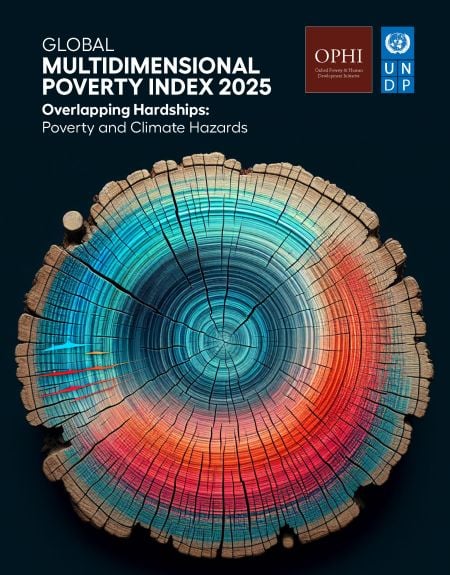
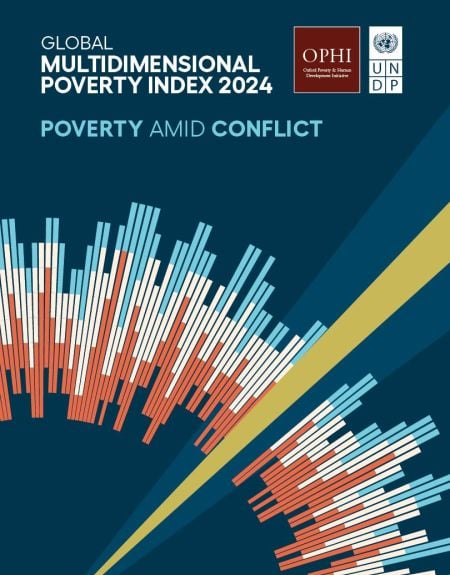
In a working paper by the Oxford Poverty and Human Development Initiative, Oxford, UK, this month, Sabine Akire and Maria Emma Santos present a new method for measuring and comparing poverty in 104 developing countries: the multidimensional poverty index (MPI). This index is a composite of three dimensions that are made up of ten indicators—health (child mortality, nutrition), education (years of school education, child enrolment), and living standards (electricity, drinking water, sanitation, flooring, cooking fuel, assets). The base population for the MPI is the household, and the emphasis is on the individual rather than on the country. For example, there are 3000 times more people living in India than in the Maldives, but according to the Millennium Development Goals (MDGs) India and the Maldives each contribute equally as a south Asian country. According to the MPI, 1659 million (31·7%) of 5230 million people (78·5% of world's population) in developing countries live in acute poverty (on US$1·25—2 per day). 29·5% of people in developing countries live in south Asia; this region contributes 51% of individuals living in developing countries who are poor—1·8 times the total poor population in sub-Saharan Africa. Bihar, the poorest state in India, has more poor people (95 million) living there than do nine of ten poorest countries in Africa. The MPI enables the identification of concomitant deprivations within households, and the clustering of deprivations in different countries. Therefore, its use will assist governments and policy makers to implement relevant interventions to remove these deprivations, address any urban—rural differences, and ensure that countries make progress towards the achievement of the MDGs (because eight MPI indicators are directly linked to the MDGs). Even in regions that are not as poor as south Asia and sub-Saharan Africa, millions of people live in acute poverty. Governments and policy makers need to focus on all individuals living in poverty, and not only those living in a region defined as poor, or on meeting set targets; all people should be helped out of the poverty trap.

Return to the list <<<<<


Back to top

2013 Report

  • Home
  • Site Map
  • Contact Us
  • Employment
  • Internships
  • Terms of Use
  • Webmaster
  • Get email updates