
Understanding the Present to Unveil the Future
Notebook I: Inequalities and New Challenges - Panama National Human Development Report 2024
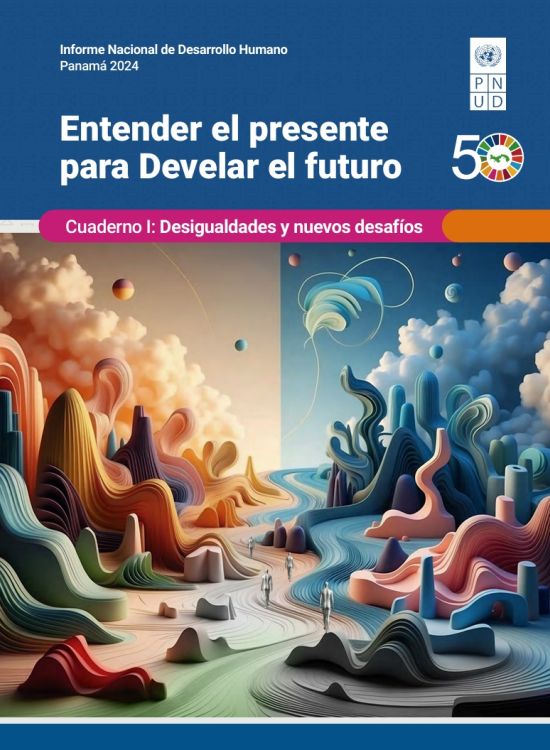
UNDP (United Nations Development Programme). 2024. Understanding the Present to Unveil the Future: Notebook I: Inequalities and New Challenges - Panama National Human Development Report 2024. New York.
Understanding the Present to Unveil the Future
Notebook I: Inequalities and New Challenges - Panama National Human Development Report 2024
Panama has achieved remarkable progress in recent decades, reaching very high human development levels, sustained economic growth, and reductions in poverty. However, these advances coexist with deep and persistent inequalities that continue to limit opportunities for many people across the country.
This first volume of the 2024 National Human Development Report examines how inequalities are shaped by geography, income, gender, ethnicity, and access to essential services. The report highlights stark disparities in education, health, housing, employment, social protection, and digital connectivity, particularly affecting rural areas, Indigenous territories, women, and low-income households. These inequalities often reinforce one another and can be transmitted across generations.
The report argues that economic growth alone does not guarantee equal opportunities. Instead, inclusive institutions, quality public services, and stronger social cohesion are needed to ensure that development benefits all Panamanians. It identifies five key mechanisms that reproduce inequality: territorial disparities, unequal access to education and health, segmented labor markets, unequal wealth accumulation, and perceptions of unfairness in the political and economic system.
Looking ahead, the report explores two major forces that will shape Panama’s future: technological change and climate change. While digital transformation and innovation offer significant opportunities, they could also widen existing gaps unless accompanied by investments in skills, connectivity, and inclusive labor market policies. Similarly, climate change disproportionately affects vulnerable communities and threatens livelihoods, water security, biodiversity, and long-term development prospects.
The report concludes that reducing inequality is essential for sustainable development, social cohesion, and democratic stability. It calls for stronger social protection systems, investment in education and innovation, inclusive environmental governance, and participatory decision-making to ensure that Panama’s future is more equitable, resilient, and prosperous for present and future generations.