
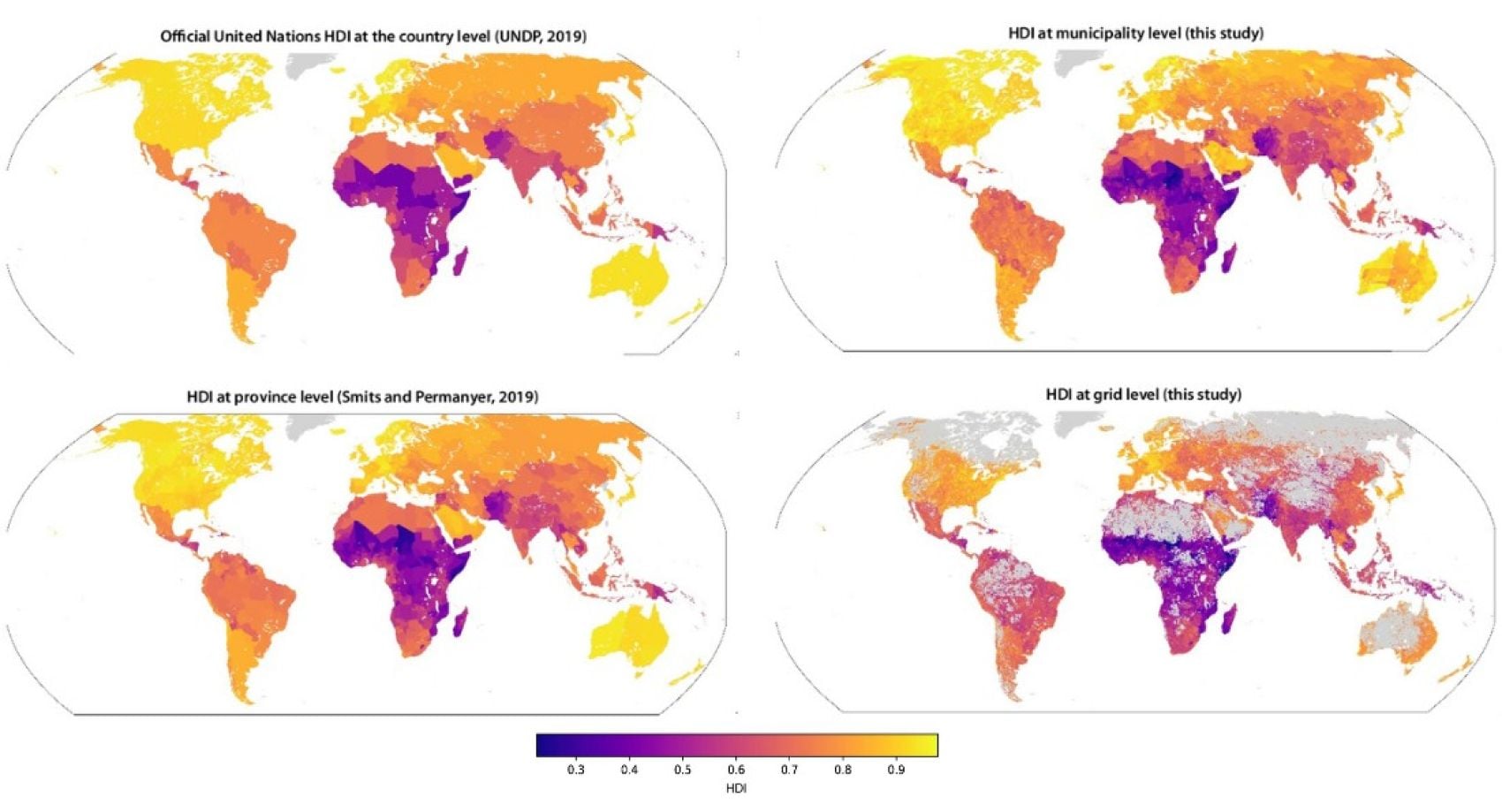
For more than 35 years, UNDP’s Human Development Report Office (HDRO) has produced the Human Development Index (HDI) for countries—helping shift the global conversation beyond income alone. But human development can vary sharply within countries, and it has often been difficult to generate consistent local estimates where subnational data are limited.
A new study published 17 February 2026 in Nature Communications shows how satellite imagery and machine learning can extend the HDI from national averages to more local estimates—helping reveal within-country disparities that national statistics can miss.
The research uses satellite imagery and machine learning to generate local HDI estimates, providing a clearer view of patterns within countries. The study reports results for 61,530 municipalities and counties worldwide and also assesses differences using 10-by-10-kilometer grid tiles—highlighting how conclusions can change as measurement becomes more geographically detailed.
The work is co-authored by Heriberto Tapia, Research and Strategic Partnership Advisor, UNDP Human Development Report Office (HDRO), with academic collaborators at the Stanford Doerr School of Sustainability, the California Institute of Technology (Caltech), and the University of British Columbia (UBC). It reflects HDRO’s continued investment in innovating on human development metrics, and in partnerships with leading research institutions to strengthen the evidence base for policy.
The estimates are generated by a model from satellite imagery, rather than measured directly in every location. They are designed to complement—not replace—official national HDI reporting, and their precision can vary across contexts.