

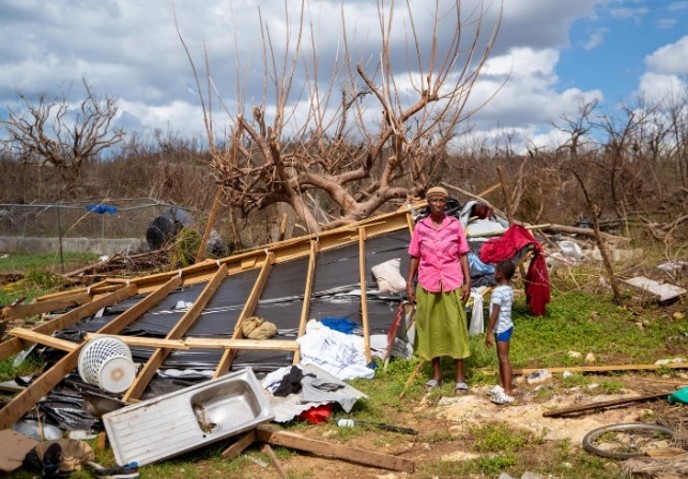
Making landfall on 28 October 2025 in Jamaica, Hurricane Melissa was the strongest hurricane on record to make landfall in Jamaica, bringing loss and damage to infrastructure, property, livelihoods and ecosystems - equivalent to 57% of the country’s GDP. For a country that produces a very small share of global carbon emissions, but faces the brunt of climate impacts, this has emerged as a globally relevant and historic case of the injustice and far-reaching impacts of the planetary crisis. In the days after landfall, my team and I at the UNDP Multi-Country Office in Jamaica visited the epicenter of impact, near the towns of Black River and New Hope.

| Among many impacted community members, we met Keith, a resident who experienced firsthand ways in which the planetary crisis is reshaping human development. Keith arose that day and upon looking up saw a tunnel of light descending straight down from the sky, through which he saw the shining sun above, and what he described as a beautiful yellow and orange glow radiating all around. |
At first, he thought the storm had passed, but he was wrong. Keith was in the eye of the hurricane. Not long after he was pummelled to the ground by the record-setting winds. Quickly grabbing a stray piece of sheet metal, he ran to a nearby structure, kneeled in a corner and held tight to the thin sheet for hours. Upon opening his eyes, what Keith saw was unimaginable devastation. The lush watersheds and forest landscapes that fueled local livelihoods were decimated, as were his local shop and household.
Far from an academic exercise, the planetary crisis is no longer a dystopian tale of the future, already reversing countries’ hard-won development gains. This is nowhere more apparent than in Small Island Developing States (SIDS). As highlighted in a new Background Paper for the HDR, Caribbean SIDS in particular are on the frontlines of the planetary crisis, with critical lessons for rethinking future development pathways.
Keith was born in New Hope, as were his parents and others before them. Resilience to injustice and crisis is deep-rooted in this part of the world. Just down the road, the town of Black River was linked to the infamous Zong massacre of 1781, when the captain of the ship Zong threw overboard more than 130 enslaved Africans before arriving at Black River port, followed by a deceptive insurance claim for the loss. The epicenter of Hurricane Melissa’s landfall expresses sharply the connections between past, present and future and the socially and ecologically extractive foundations of modernity.
The ferocity of this event reminds us that planetary and human futures have roots in the past, and that it may recur in the future, unless collective action is taken to secure a more just and resilient future. While scaled-up action on inclusive development, climate adaptation and ecosystem restoration are needed across SIDS, an equally urgent task is to recast conventional development paradigms, with a view to new aspirational solutions that can reconnect humans and nature.
The world of development has entered a new era of complexity, driven by shifts in geopolitics, the rise of AI, growing inequalities, and the planetary crisis of climate change and ecological disruption. The latter is particularly consequential, with atmospheric carbon dioxide having reached levels not seen in over three million years, and ecosystems likely facing onset of the sixth mass extinction in the Earth’s history. Given the far-reaching consequences for future development pathways, the upcoming 2026 edition of the Human Development Report (HDR) will focus on planetary and human futures, proposing a new metric on the human-nature relationships, and exploring aspirational approaches to strengthen the relationships among people and with nature on which development depends.
| To this end, a Thought Leaders Dialogue was co-convened in June 2026 by UNDP and The University of the West Indies (UWI), a consultation to bring forth the lived experiences of Caribbean SIDS into the HDR process. The dialogue mobilized academic thought leaders from various disciplines across UWI and leadership from UNDP’s Human Development Report Office to share insights on ways to break through the epistemic boundaries of conventional development approaches and chart as aspirational approach towards and beyond 2030. |
As noted during the dialogue, the severity of Hurricane Melissa reshaped communities and landscapes, but it also catalysed government and communities to rethink development. These and other insights were reflected in a new UNDP Policy Brief ‘Beyond 2030: A Transformational Architecture for Delivering Sustainable Development’ focused on transformative solutions from a SIDS perspective. A particular focus during the roundtable discussions was on the shift to nature-based solutions, with findings clustered into three key areas of future action, aligned with UNDP’s Nature Pledge.
A key means of transformation is through a Value Shift. The existential nature of Hurricane Melissa resonated deeply across society, a moment which is catalysing a shift in values as decision-makers and communities increasingly recognize nature as a foundation for human security and resilience. Moving forward, scope exists to build on this process to rethink key features of classic development systems. One example is the central concept of agency, with calls to shift from conventional human-centred approaches, to embrace new distributed concepts of agency within ecosystems at the centre. Many also see the rise of a new spirit of environmental citizenship and ecological rights emerging. This builds on the 2026 Bengal case, a Constitutional Court decision under section 13(3)(l) of Jamaica’s Constitution on the right to a healthy and productive environment. This is seen as a landmark expression of a greater recognition of nature as a basis of fundamental freedoms at the base of development, and enhanced citizen access to participation and justice in development policy setting and decision-making.
Experts also see scope for a Finance Shift, to scale up ecosystem restoration and find synergies with much-needed loss and damage finance. Increasingly, the nexus between social and ecological restoration is important for building real resilience at the community level. Meanwhile, debt swaps are also a key area for future exploration, with recent expansion of large-scale debt for nature swaps in Caribbean SIDS like Belize and The Bahamas, with a US$364 million debt conversion in Belize and an estimated US$124 million in savings for marine conservation in The Bahamas, and replication potential across other SIDS. UNDP cooperation with partners in Jamaica and the broader Caribbean on biodiversity finance policy and climate finance solutions has been key to advancing this agenda.
Lastly, potential is seen through a Policy Shift. Stronger calls have emerged for a shift from extractive-based development to nature-based pathways, along with systems to achieve social and environmental justice at the community level. Generally, the orientation of development paradigms and policies should shift to be more future-ready in an era of complexity, seeing development not as the product of a linear pathway to a set of targets, but as the emergent property of a complex socio-ecological system. UNDP cooperation with the judicial system on alternative and restorative justice mechanisms are critical, as are the series of UNDP/GEF small grants to local think tanks and NGOs generating alternative visions of future development pathways.
A deep nexus is emerging between the historic roots of socio-ecological vulnerability, the existential nature of today’s planetary crisis, and the aspirational set of solutions emerging on the road to 2030 and beyond. This could well result in the coming years in a transition from the abyss of socio-ecological tragedies and injustices faced in the Caribbean and other SIDS contexts, towards a new era of nature-based values, financing and policies, and an aspirational future where people and planet are at peace.